Our work
The details that separate a liner from a system.
Anyone can lay plastic on dirt. What separates a system is how the seams, the walls, the piers and the penetrations are treated.
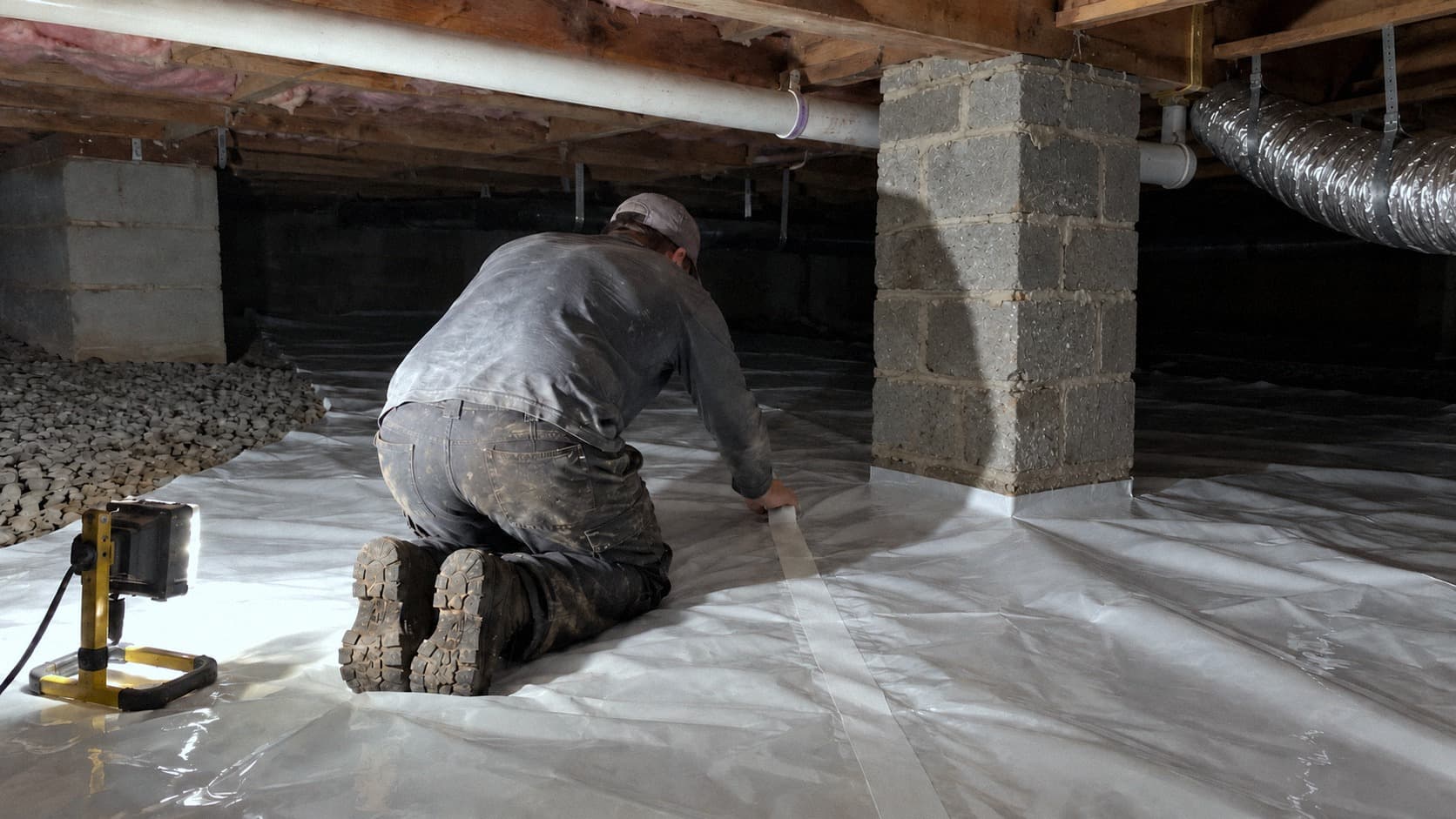
Fig. 1 Seams
Seam overlap and sealing
Laps of at least 12 inches, twice the model code, sealed with mastic and mesh on clean, dry plastic, and run upslope so water crosses a seam rather than entering it.1
Fig. 2 Wall edge
Wall termination and fastening
The top edge of the wall liner is fastened with masonry screws through washers, over a bead of double-sided butyl tape, because tape or adhesive alone will not hold. Run full height, it stops 5 inches below the floor joists to leave the termite inspection gap.2
Fig. 3 Piers
Pier and column detailing
Each pier gets its own wrap, at least 4 inches up the column and 12 inches out onto the floor, so the floor sheet laps over a flap instead of being slit around a post.3
Fig. 4 Penetrations
Penetration treatment
Every pipe, duct and wire through the sheet gets a patch cut with an X, slid over it and taped down as a collar.4
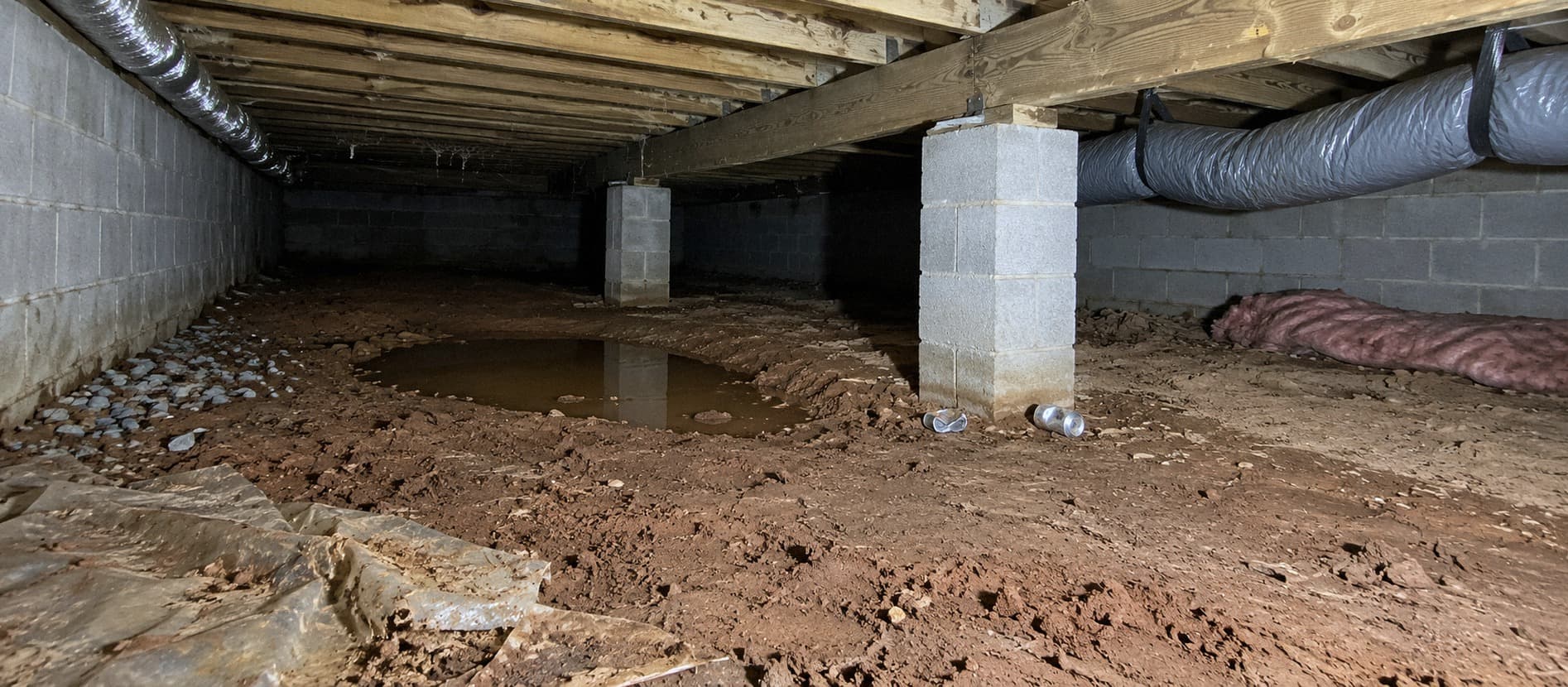 Before the sheetIllustration
Before the sheet
The floor is cleaned, cleared and graded before any plastic goes down.
Vegetation, organic material, wood scraps and rubble come out, and so does any old plastic, because covering it traps water and debris where mold can grow. Standing water is a stop: drainage first, liner second.5
Loose insulation hanging from the joist bays is rehung as part of the job, priced after the inspection.
Before and after
Wet clay and standing water, then a sealed floor and a fastened wall.
Water on a crawlspace floor is a drainage sign, and it is solved before the sheet goes down. Drag the handle to compare the two.6
Fig. 5 Before and after
Free inspection
Book your free inspection.
About an hour under the house, then one fixed price. Texts are answered right away.
Sources
- North Carolina Residential Code, R408.2 Ground Vapor Retarder
- North Carolina Residential Code 2024, R409.2.2.1 Wall Liner Termite Inspection Gap
- North Carolina Residential Code, R409.2 Groundwater Vapor Retarder
- Stego Industries, manufacturer, StegoHome installation instructions
- Advanced Energy, Closed Crawl Spaces: An Introduction for the Southeast
- USDA Forest Products Laboratory / ASHRAE, Issues in Crawl Space Design and Construction (1994)